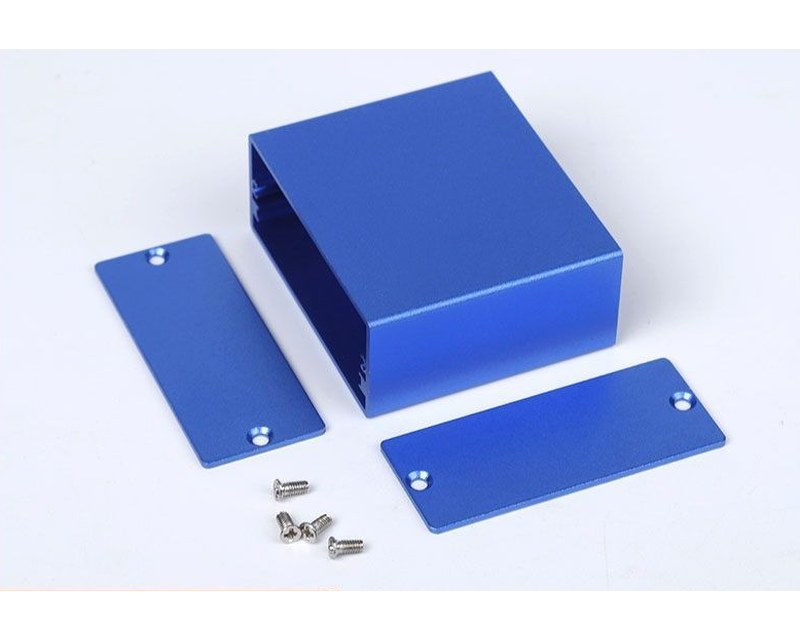
The four finishes that cover 95% of orders
Clear anodizing (Type II). The natural look: silver, fine grain, hard enough for handling and cleaning. It is the default for instrument housings and the cheapest way to make extrusion look finished.
Black or coloured anodizing (Type II). Same process with dye. Black is the most common request for consumer-facing electronics. Colour matching across batches is good but not perfect — expect a small ΔE variation between lots.
Powder coating. 60–100 µm of polyester powder, cured at 180–200 °C. Thicker and more impact-resistant than anodizing, available in any RAL colour, and it hides minor surface marks. It is also an insulator and adds 0.06–0.1 mm per surface — relevant for tight fits.
Sandblasting / brushing. Often a pre-treatment rather than a final finish. Blasting gives a matte, uniform base before anodizing; brushing gives a directional grain that looks premium on front panels.
Comparison
| Finish | Cost index | Durability | Electrical conductivity | Best for |
|---|---|---|---|---|
| Mill finish | 1.0 | Low — fingerprints, oxidation | Yes | Hidden/internal parts |
| Sandblasted + clear anodize | 1.3 | Good | No (insulating) | Instrument housings, premium look |
| Black anodize | 1.4 | Good | No | Consumer electronics, audio |
| Hard anodize (Type III) | 1.9 | Excellent, 25–50 µm | No | Wear parts, outdoor, marine |
| Powder coat | 1.5 | Excellent impact, UV stable | No | Industrial, any RAL colour |
| Chromate conversion (Alodine) | 1.2 | Moderate, conductive | Yes | EMI/grounding, internal surfaces |
| Laser marking | +0.2 | Permanent | — | Logos, serials, on anodize |
Anodizing: what actually matters
- Alloy. 6063 anodizes beautifully and evenly. 6061 is acceptable. Die-cast A380 contains silicon and copper and anodizes to a dark, patchy grey — if you want a clean black die-cast housing, powder coat it instead.
- Type II vs Type III. Type II is decorative/protective, 10–25 µm. Type III (hard) is 25–50 µm, much harder, and dims sharp edges slightly.
- Masking. Threads, sealing grooves and grounding pads must be masked. Build this into the drawing; discovering it after anodizing means scraping parts.
- Colour consistency. Anodized colour depends on alloy lot, bath chemistry and part position. For a product family, run all parts in one batch.
Powder coating gotchas
- Tolerance stack. 80 µm per surface is 0.16 mm across a joint. Mask sealing faces or the O-ring compression changes.
- Grounding. Coating is an insulator. Specify a masked grounding boss or a conductive gasket.
- Edge coverage. Sharp edges coat thin. A 0.5 mm radius improves coverage and looks better.
- Cure temperature. 180–200 °C is fine for aluminum, but check any pre-assembled inserts or labels.
Finish + IP rating together
Anodizing under a gasket is a bad idea: the brittle oxide layer micro-cracks when compressed and creates a leak path. Mask the sealing groove and keep it bare or chromate-converted, with Ra 1.6 or better.
What we recommend by application
| Application | Finish |
|---|---|
| Indoor instrument, silver look | Sandblast + clear anodize |
| Audio / consumer electronics, black | Black anodize, laser logo |
| Outdoor sensor, coastal | Hard anodize + masked seals + vent |
| Industrial control, any colour | Powder coat, masked grounding points |
| EMI-critical housing | Chromate conversion inside, finish outside |
Send us the drawing with the finish callout and the masking requirement, and the first article will match the production parts.
FAQ
Does anodizing insulate the housing electrically?
Yes. Type II anodizing is an insulating oxide, roughly 1–3 µm of dielectric per volt is the wrong way to think about it — practically, an anodized surface will not provide a reliable ground path. Mask contact points or use chromate conversion where grounding is required.
Which finish lasts longest outdoors?
Hard anodizing (Type III) or a quality powder coat. Both survive UV and salt spray for years; clear Type II anodizing is fine but thin and can chalk in strong sun.
Can I have colour and conductivity?
Yes, with masking: anodize or coat the visible surfaces and mask the grounding pads, or specify chromate conversion (Alodine) on the interior and finish only the exterior.
Send us your housing spec
STEP or dimensioned PDF, target IP rating and annual volume. We answer with a price and a marked-up drawing — usually within one working day.