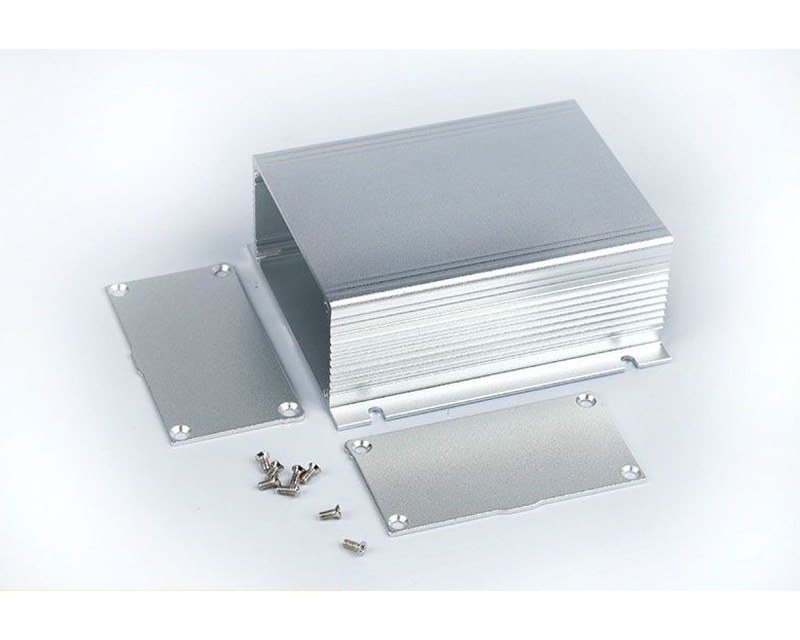
The short answer
If your housing is a rectangular box, your annual volume is under a few thousand pieces, or you want heat-sink fins built into the walls, use extruded aluminum. If the shape has compound curves, internal ribs, or a complex sealing geometry and you need 10,000+ pieces per year, die casting starts to pay off.
For most electronics projects the enclosure is a box with holes in it — and a box is exactly what extrusion does best.
How each process works
Extrusion. A 6063 aluminum billet is pushed through a steel die to create a constant cross-section: a tube, a U-channel, a finned profile. The profile is cut to length, then machined. Everything that varies along the length — end plates, cutouts, tapped holes — is added by CNC afterwards.
Die casting. Molten A380 or ADC12 alloy is injected into a steel mould under high pressure. You get a near-net-shape part with draft angles, bosses, ribs and mounting features in one shot. Anything precise — sealing grooves, bearing bores, threads — is still machined afterwards.
Side-by-side
| Extruded (6063-T5) | Die-cast (A380 / ADC12) | |
|---|---|---|
| Tooling cost | Die already exists for public-mold profiles; new profile USD 1,500–4,000 | USD 3,000–15,000+ |
| Tooling lead time | none (stock) / 3–5 weeks (new die) | 4–8 weeks |
| Economic volume | 10 – 50,000 pcs/yr | 5,000 – 500,000 pcs/yr |
| Wall thickness | 1.2 – 2.5 mm, uniform | 2.0 – 4.0 mm, varies |
| Shape freedom | Constant section only | Complex 3D, ribs, bosses, curves |
| Surface finish | Excellent for anodizing (uniform grain) | Good, but porosity can show after polishing |
| Heat dissipation | Very good — fins are free in the profile | Fair — needs added mass or fins |
| Sealing | End-plate gasket + machined groove | Integral groove possible, but machining required |
| Weight | Lighter for the same strength | Heavier walls |
Where each one wins
Choose extrusion when
- Your product is a rectangular instrument, power supply, LED driver, sensor node or amplifier.
- You want the housing itself to be the heat sink. Extruded fins cost nothing extra — they are part of the profile.
- You need 10–2,000 pieces with cutouts and finishing, and cannot absorb a tooling charge.
- You want the same housing in several lengths. One profile, five cut lengths, five SKUs.
Choose die casting when
- The industrial design has curves, a sloped face, or a handle integrated into the body.
- You need internal bosses and ribs for PCB mounting and drop resistance in one part.
- Volume is high enough that a USD 10,000 tool spread over 50,000 units (USD 0.20/unit) is irrelevant.
- You need IP67/IP68 with a moulded-in gasket channel and a single parting line.
The sealing question, in detail
Water almost never enters through the extrusion. It enters at:
- The end-plate joint. A machined groove holding a 2 mm O-ring, compressed 25–30%, beats a flat gasket every time.
- Cable entries. A gland with a proper sealing washer, torqued to spec. An unsealed hole is an open door.
- Screw holes that break through. Blind tapped holes, or screws with sealing washers.
- Pressure cycling. A sealed box that heats and cools pulls water in through the weakest point. A breathable vent (Gore-type membrane) solves this and keeps IP67.
An extruded housing with a machined O-ring groove, six to eight M3 screws at 0.5 N·m and sealed glands will hold IP67 in production. We test by immersion rather than trusting the drawing.
Cost math for a 100 × 68 × 50 mm housing
At 500 pieces, a typical public-mold extruded housing with CNC cutouts, anodizing and assembly sits in the USD 4–9 range depending on the number of features. The same part as a new die casting, including tooling amortised over 500 units, is usually two to four times that. At 50,000 units the die casting wins on unit price by 20–40%.
What to send us
For an extruded quote: PCB dimensions with connector positions, the number and type of cable entries, IP target, finish, colour, and annual quantity. A STEP file is ideal; a PDF with dimensions works.
For die casting: the same, plus the industrial design surfaces and an indication of whether draft angles can be added.
FAQ
Is die-cast stronger than extruded aluminum?
Not necessarily. Die-cast alloys such as A380 have lower elongation and can contain porosity, while 6063-T5 extrusion is homogeneous along its length. For impact resistance, extruded housings with 1.5–2 mm walls usually outperform thin-wall die castings.
Can I get IP67 with an extruded enclosure?
Yes. An extruded body with machined end plates, an O-ring or moulded gasket in a machined groove and sealed cable entries reaches IP67. The end-plate joint, not the extrusion, is where water gets in, so the groove and screw spacing matter more than the process.
Which process is cheaper at 200 pieces?
Extrusion, almost always. A die-cast tool costs USD 3,000–15,000, which is hard to amortise over 200 units. Extruded profiles cut from existing dies carry no tooling charge, so 200 pieces is a normal order.
Send us your housing spec
STEP or dimensioned PDF, target IP rating and annual volume. We answer with a price and a marked-up drawing — usually within one working day.