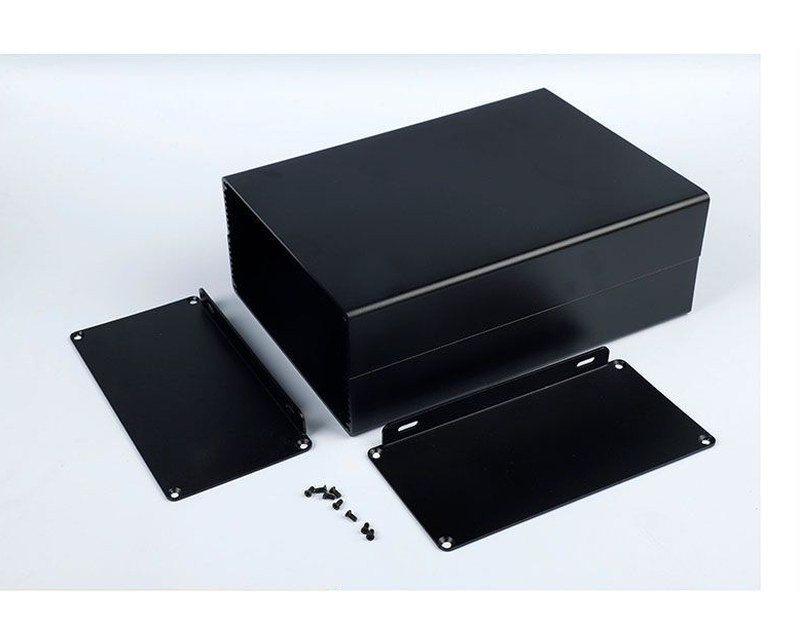
How cutouts are made on an extruded body
The profile arrives as a cut length. It goes into a machining fixture, and a CNC mill (or a punch press for simple shapes) cuts the connector openings, gland holes, display windows and button apertures. Threads are cut with a tap or a thread mill.
Two consequences: there is no tooling charge for the profile, and each unique cutout pattern has a one-off setup cost — usually modest, but real for small quantities.
What to send
A 2D drawing with:
- Every hole and opening dimensioned from one datum (machined end face + one edge).
- Thread callouts: M12×1.5, M16×1.5, M20×1.5, PG7, PG9, PG13.5.
- Wall thickness at the entry, or a note that a boss is required.
- Edge break: 0.3–0.5 mm chamfer or radius is standard; sharp edges cut gasket washers.
- Any keep-out zone around the connector (latch swing, cable bend).
STEP helps for curved features but does not replace the dimensioned drawing.
Gland holes: the sealing details
A cable gland seals in three places: the cable (compression nut), the panel (sealing washer), and the thread. Get any of them wrong and IP65 fails.
- Thread engagement. At least 4–5 full threads. M12×1.5 in 6 mm of aluminum is fine; in a 2 mm extrusion wall, add a machined boss.
- Flat seating face. The washer needs a flat, burr-free face at least 2 mm larger than the gland's sealing diameter. On a curved or finned surface, machine a spot face.
- Burr removal. A burr under the washer is a leak path and also cuts the rubber.
- Washer material. Neoprene or EPDM depending on UV and oil exposure; a metal-backed washer is better on thin walls.
- Torque. Follow the gland's spec (typically 2–3 N·m for M12 plastic, 4–6 N·m for metal). Over-torque splits the insert.
Cable management matters as much as the gland
- Strain relief. A gland clamps the jacket; if the cable is stiff and side-loaded, the seal distorts. Add a P-clip inside.
- Bend radius. Leave 6–8 mm behind the panel for the plug body, and do not route the cable against a sharp internal edge.
- Grouping. Two cables through one gland only works if the gland is sized for the bundle — otherwise use a multi-entry insert.
Common mistakes we see
| Mistake | Result | Fix |
|---|---|---|
| Gland threaded into 1.5 mm wall | Wobbly, leaks under vibration | Machined boss, 6 mm engagement |
| No spot face on a finned side | Washer sits on a fin edge | Machine a flat pad |
| Cutout dimensioned from two datums | Holes 0.5–1 mm off | One datum |
| Sharp cut edges | Gasket cut on assembly | 0.3 mm chamfer |
| USB-C opening sized to the metal shell only | Plug body hits the wall | Draw the plug body and bend radius |
Cost and lead time
For a stock housing, cutouts typically add USD 1–4 per unit depending on count and complexity, plus a small one-off programming charge for a new pattern. Samples with cutouts run three to five working days; production runs of 500 pieces, about two weeks including finishing.
Send the drawing and we will come back with a marked-up version showing what is achievable on the chosen profile — before any metal is cut.
FAQ
What is the minimum wall thickness for an M12 gland thread?
M12×1.5 needs about 4–5 full threads, so 6 mm of material minimum. On a 2 mm extrusion wall, use a machined boss or a bulkhead adapter rather than threading the wall itself.
Can you add cutouts to a stock housing without a new tool?
Yes. Cutouts are CNC milled or punched in a machining fixture; no new extrusion die or mould is needed. Setup cost is a one-off per unique pattern.
What tolerance should I expect on a milled cutout?
±0.1 mm on position from a machined datum and +0.1/0 mm on the opening, with a surface finish of Ra 3.2 inside the cut. Tighter is possible but adds cost.
Send us your housing spec
STEP or dimensioned PDF, target IP rating and annual volume. We answer with a price and a marked-up drawing — usually within one working day.