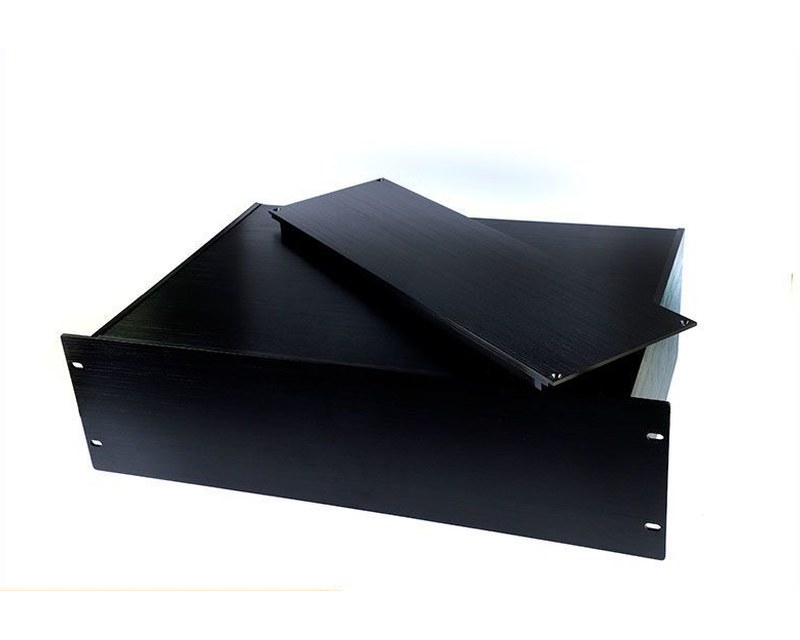
A metal box is a shield with holes in it
Aluminum reflects and absorbs RF well. The problem is that a shielding enclosure is only as good as its worst seam. A 100 mm slot between two poorly bonded panels behaves like a slot antenna and can radiate more than an open hole of the same area.
Three things matter: seam bonding, aperture size, and cable entry.
Seams
Two painted or anodized flanges screwed together are not bonded. The oxide or coating is an insulator, and contact happens only where the screw threads bite.
Fixes, in order of cost:
- Mask the mating flange during anodizing or powder coating, so bare aluminum meets bare aluminum.
- Increase screw density — 25–40 mm pitch rather than 80 mm.
- Conductive gasket — fabric-over-foam, knitted mesh or silicone with nickel-graphite filler, 2–3 mm thick, in a machined groove or on a flat flange.
- Finger stock / spring contacts for lids that open often.
A conductive gasket typically gives 40–80 dB of attenuation from 100 MHz to 1 GHz when the flange is properly compressed. It also seals dust and water, so one part does two jobs.
Apertures
Any opening larger than about λ/20 at the frequency of concern leaks. At 1 GHz, λ/20 is 15 mm.
- Ventilation slots. Keep individual slots under 20 mm, or use a honeycomb vent panel.
- Displays. A conductive window (mesh, ITO coating) bonded to the bezel.
- Connector cutouts. Keep the gap to the connector body small; a metal-shell connector bonded to the panel is best.
- Gland holes. A plastic gland in a metal wall is a hole. Metal glands or shielded cable entry preserve the shield.
Cables are the usual culprit
Most radiated-emissions failures come from cables acting as antennas, not from the box. A signal cable leaving an unshielded connector carries common-mode current out of the enclosure and radiates it.
- Use shielded cable with the shield bonded to the chassis at the entry point (360° termination, not a pigtail).
- Add a feedthrough capacitor or a common-mode choke on power lines.
- Keep high-speed traces away from panel edges and connector pins.
Grounding
One low-impedance reference, not several hopeful ones.
- Bond the housing to the PCB ground at one deliberate point (or several, if you have analysed the loop).
- Use a masked grounding boss with a star washer, or a chromate-converted (Alodine) surface — it conducts and still resists corrosion.
- Do not rely on anodized threads for grounding.
Compliance context
For most electronics sold in the EU you are testing against EN 55032 (emissions) and EN 55035 (immunity); in the US, FCC Part 15. Automotive and medical have their own, harsher, requirements.
A practical development sequence: get the enclosure design right early (masked flanges, gasket groove, short cable runs), then test. Retrofitting shielding into a finished industrial design is expensive.
What to specify on the drawing
- Conductive gasket groove, dimensions and compression.
- Masking of mating flanges and grounding pads.
- Screw pitch on the lid.
- Any vent or display window with its attenuation requirement.
- Cable entry type and shield termination method.
If you tell us the standard you are testing to and the highest frequency of concern, we can suggest a gasket and screw pattern before the first prototype is cut.
FAQ
Is an anodized aluminum enclosure still an effective shield?
The metal reflects, but the anodized surface is an insulator, so the lid may not make electrical contact with the body. Mask the mating flanges, or use a conductive gasket that penetrates the oxide.
How far apart should screws be for good shielding?
A common rule is spacing below one-twentieth of the wavelength at the highest frequency of concern — 30 mm at 500 MHz, 15 mm at 1 GHz. Practical enclosures use 25–40 mm pitch plus a conductive gasket.
Do I need shielding if my product is not wireless?
You need to pass emissions (EN 55032 / FCC Part 15) and immunity tests. A metal housing usually gets you most of the way; the failures come from cables leaving the box.
Send us your housing spec
STEP or dimensioned PDF, target IP rating and annual volume. We answer with a price and a marked-up drawing — usually within one working day.