Start with the arithmetic
Heat leaves a sealed box by two paths: convection to the air around it, and radiation. For a first estimate, use a combined coefficient of h ≈ 6–10 W/(m²·K) for natural convection in still air, with the higher end for a vertical, finned, dark surface.
ΔT = P / (h × A)
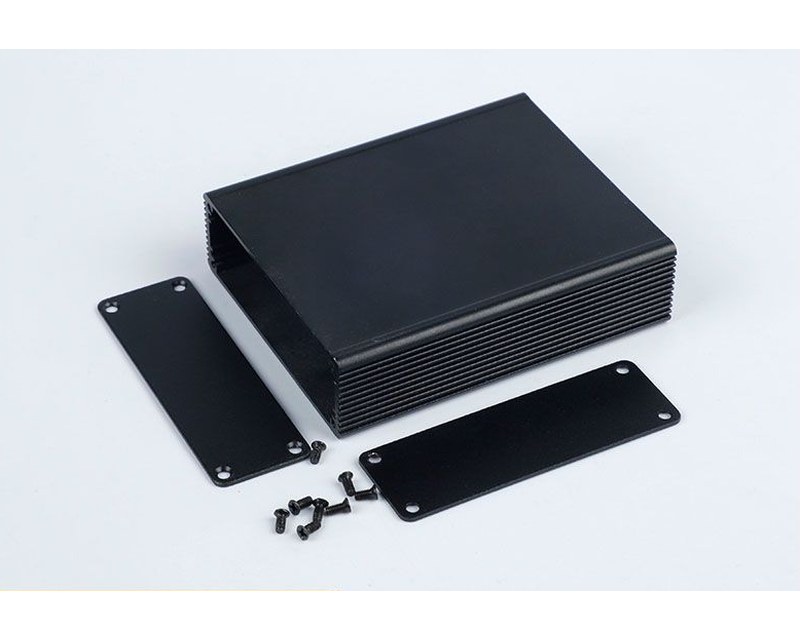
A 100 × 68 × 50 mm housing has an external area of roughly 0.03 m². With h = 7 and P = 10 W:
ΔT = 10 / (7 × 0.03) ≈ 48 K
So a 25 °C room becomes 73 °C at the housing wall — and the junction inside is hotter still. The same box at 5 W runs about 24 K above ambient.
Two things follow. First, small boxes cannot dissipate much. Second, the internal path matters as much as the external area: if the heat source is not coupled to the wall, the wall stays cool while the component cooks.
The internal thermal path
Heat must travel: junction → package → PCB → (air gap or pad) → housing → ambient.
That gap between the component and the wall is usually the bottleneck. Air is a terrible conductor (0.026 W/m·K). A 1 mm air gap under a 10 × 10 mm package is roughly 380 K/W; a 1 mm gap pad at 3 W/m·K is about 3 K/W.
Options, cheapest first:
- Move the hot part to the wall. Mount the MOSFET or regulator flat against the aluminum with a thermal pad and a screw. This is free and usually the biggest win.
- Gap pad / thermal tape. 0.5–2 mm silicone pad, 1.5–6 W/m·K, die-cut to the footprint.
- Thermal potting. Filled epoxy or silicone, 1–3 W/m·K, fills everything and adds IP protection — but it is permanent and adds mass.
- Aluminum PCB or heat spreader clamped to the housing for high-power LED or motor drive designs.
- Heat pipe or vapour chamber — only when nothing else fits.
External options
Fins. In an extrusion, fins cost nothing extra: they are part of the profile. Vertical fins spaced 4–6 mm with 10–15 mm depth roughly double the effective area. Fins work when the box is mounted vertically; horizontal fins trap hot air.
Surface finish. Black anodize raises emissivity from ~0.05 to ~0.85. Radiation is perhaps 20–30% of the total at these temperatures, so expect a 10–20% improvement — but it is free and also looks better.
Mounting. A housing bolted to a steel panel conducts heat into the panel. A housing on rubber feet in still air does not.
Vent. A membrane vent does not add much convective cooling, but it prevents pressure cycling and lets a small amount of vapour escape. It is a reliability measure, not a thermal one.
When to use a fan
Only when the arithmetic says you are 15 K over budget and there is no room for fins. A fan adds a failure mode, noise, dust ingress, and it fights the IP rating. A 40 mm fan at 8 m³/h is worth roughly 5–10 W of dissipation in a small enclosure — sometimes that is the whole problem solved.
A worked example
Target: 5 V, 3 A power module, 12 W dissipated, ambient 40 °C max, junction limit 105 °C.
- Allowed rise: 65 K total.
- Junction to case (module): 3 K/W × 12 W = 36 K.
- Case to housing via 1 mm gap pad (3 W/m·K, 20 × 20 mm): 0.83 K/W × 12 W ≈ 10 K.
- Housing to ambient: 65 − 36 − 10 = 19 K available.
- Required h × A = 12 / 19 = 0.63 W/K. With h = 7, A = 0.09 m² — a 150 × 100 × 60 mm finned housing.
Change the gap pad to a direct screw mount and step 3 drops to 2 K, gaining 8 K of margin — enough to use a smaller box.
Practical checklist
- Mount power components to the wall, not in the middle of the board.
- Specify a finned profile if the load is above 5 W.
- Use a gap pad with a published W/m·K figure, not "thermal tape".
- Keep electrolytic capacitors away from the hot wall.
- Black anodize if the housing is visible.
- Add a vent if the box is sealed and cycles in temperature.
- Test at maximum ambient with the real load, not at 25 °C on a bench.
FAQ
How many watts can a sealed aluminum box dissipate?
For natural convection, roughly 3–8 W per 0.01 m² of exposed surface at a 30 K rise, depending on orientation and finish. A 100 × 68 × 50 mm housing has about 0.03 m², so 10–20 W is realistic with a good internal thermal path.
Do black anodized housings run cooler?
Slightly. Emissivity rises from about 0.05 for bare aluminum to 0.85 for black anodize, which improves radiation by 10–20% at typical enclosure temperatures. Convection dominates, but the finish is free.
Does a vent hurt the IP rating?
A proper ePTFE membrane vent does not. It passes air and vapour but blocks liquid water well beyond IP67, and it prevents the pressure cycling that stresses gaskets.
Send us your housing spec
STEP or dimensioned PDF, target IP rating and annual volume. We answer with a price and a marked-up drawing — usually within one working day.