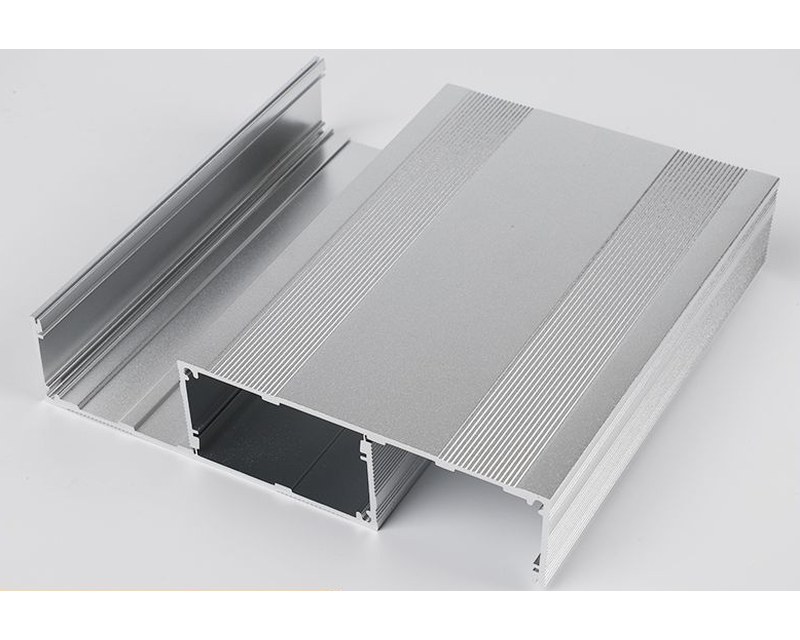
What "public mold" actually means
An aluminum extrusion die is a steel disc with a shaped orifice. Someone pays for it once; after that, every metre of profile pushed through it is cheap. When a factory already owns the die — either because it designed the profile for its own catalogue or because a customer paid for it years ago — that die is public for anyone ordering from that factory.
Buyers call these "stock profiles", "existing tooling" or "public mold" housings. There are thousands of them: rectangular instrument boxes, finned power-supply housings, DIN-rail bodies, small sensor tubes.
The economics
| Public mold | Private die | |
|---|---|---|
| Tooling fee | 0 | USD 1,500–4,000 (extrusion) / 3,000–15,000 (die cast) |
| Tooling lead time | none | 3–5 weeks (extrusion), 4–8 weeks (casting) |
| First sample | 3–5 days | 5–7 weeks |
| Minimum order | 10 pieces | usually 300–1,000 kg of extrusion |
| Shape | fixed cross-section | anything you design |
| Price per piece | metal + machining + finish | slightly lower, plus amortised tooling |
The break-even is simple. If a private die costs USD 3,000 and saves USD 0.40 per housing, you need 7,500 units before the die pays for itself — and that ignores the five weeks of schedule.
What you can still customise on a stock profile
Everything except the cross-section:
- Length. One profile, five cut lengths, five SKUs — free variation.
- End plates. Machined from 3–5 mm plate, any hole pattern, gasket groove optional.
- Cutouts. Connectors, displays, buttons, vents, cable glands — CNC milled to your drawing.
- Threads and bosses. Tapped holes, pressed standoffs, machined shelves for the PCB.
- Finish. Anodizing (clear, black, colour), powder coating, brushing, laser marking.
- Assembly. Kits with gaskets, screws, glands or fully assembled.
In practice a stock profile plus good machining looks like a custom product. What it cannot be is a shape the extrusion die was not made for.
When to buy your own die
Buy a private profile when at least two of these are true:
- Volume above roughly 5,000 housings per year, sustained.
- The cross-section must carry a specific PCB width, a specific connector row, or a locking feature.
- You need a proprietary look — visible fins, a chamfer, an integrated handle.
- You are losing sales because the closest stock profile wastes 15 mm of space.
- You can carry USD 3,000–4,000 of NRE and five weeks of lead time.
If only one is true, stay on a stock profile and spend the money on machining and finish instead.
How to pick a stock profile fast
- Measure your PCB and the tallest component. That gives internal width and height.
- Add 2–3 mm per side. Search the catalogue for the nearest external size.
- Check the wall thickness — 1.5 mm is fine for M3 threads with 4 mm engagement.
- Check whether fins are on the right face for your airflow.
- Check the end-plate options: flat plate, plate with gasket groove, or plate with integrated glands.
Our catalogue lists 262 sizes from 35 × 35 mm to 300 × 200 mm with the internal dimensions and wall thickness for each, which is the information most catalogues leave out.
The one risk to manage
Stock profiles are shared. Your competitor can buy the same body. If the housing is a visible part of your brand, differentiate with finish and graphics — a black anodized body with a laser-etched logo does not look like a generic silver box. If you need real exclusivity, that is what a private die is for.
FAQ
Is a public-mold housing lower quality than a custom one?
No. The extrusion quality is the same; what you give up is the ability to change the cross-section. Wall thickness, alloy and tolerances are fixed by the existing die, but cutouts, length, finish and end plates are fully custom.
Can competitors buy the same housing?
Yes — it is a stock profile. If exclusivity matters, buy a private die or differentiate on machining, finish and branding rather than the extrusion.
How much does a private extrusion die cost?
Typically USD 1,500–4,000 for a 6063 profile depending on size and complexity, with 3–5 weeks of die making and trial extrusion. A die-cast tool is USD 3,000–15,000.
Send us your housing spec
STEP or dimensioned PDF, target IP rating and annual volume. We answer with a price and a marked-up drawing — usually within one working day.